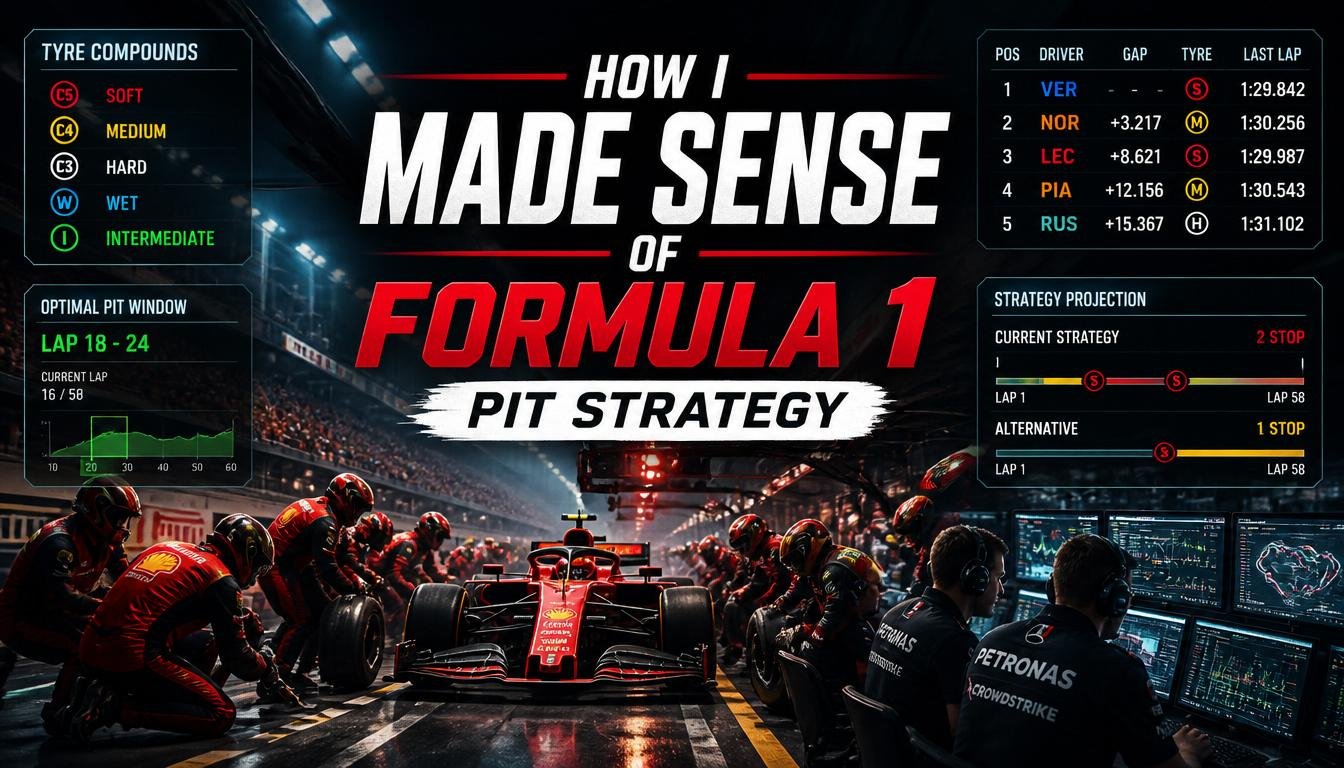
For years, I watched Formula 1 races and just accepted pit stops as background noise, cars go in, tires get changed, cars go out. Then one season I actually dug into F1 pit strategy, and suddenly races made sense in a completely different way. Here’s how I finally understood it, and how you can too.
Why Pit Strategy Confused Me for So Long:
I used to think F1 was purely about who had the fastest car and the best driver. Then I’d watch a driver in a slower car win a race purely because of smart strategy calls, and I realized I was missing half the sport.
The truth is, Formula 1 pit strategy is basically a live chess match played at 200 miles per hour. Every decision, when to pit, which tire to fit, whether to react to a rival or stay on your own plan, can swing a race result more than raw pace ever could. Once I understood the building blocks, the whole sport opened up.
The Foundation: Tire Degradation:
Everything in pit strategy starts with tire degradation, the rate at which a tire loses grip and performance over a stint. Formula 1 tires aren’t built to last the whole race. They’re built to be fast for a limited window, then they fall off a cliff in performance.
Each tire compound, soft, medium, and hard, degrades at a different rate:
- Soft tires are the fastest over a single lap but wear out quickly
- Medium tires offer a balance of pace and durability
- Hard tires last the longest but are the slowest when fresh
Teams constantly model how each compound will perform on that specific track, in that specific weather, with that specific car. That model is the backbone of every pit strategy call made during the race.
Understanding the Pit Window:
Once I understood tire degradation, the next piece clicked into place: the pit window. This is the range of laps at which it makes strategic sense for a driver to make a tire change, based on when their current tires are expected to drop off compared to the time lost by pitting.
A pit stop costs a driver real time, usually between 20 and 25 seconds, once you account for entering the pit lane, the actual tire change, and rejoining at reduced speed. That’s why teams don’t just pit whenever a tire feels a little worse. They calculate the exact lap where staying out any longer costs more time than the pit stop itself.
This is where the concept of track position becomes critical. Sometimes a driver who’s genuinely faster still can’t pit because they’d lose track position and get stuck in traffic behind slower cars, a problem made worse on tracks where overtaking is difficult.
The Undercut: My Favorite Strategy to Watch:
The single strategy that made pit calls click for me was the undercut. Here’s how it works: if you pit before a rival, your fresh tires give you a burst of extra pace right when your competitor is still out there on worn tires. By the time they pit a lap or two later, you may have gained enough time on your fresh rubber to jump ahead of them once they rejoin, even though you were behind before either of you stopped.
The undercut is essentially a bet that fresh tire performance will outweigh the track position you temporarily give up by pitting first. It’s one of the most common, and most exciting, strategic weapons in modern Formula 1 race strategy.
The Overcut: The Quieter Counterattack:
Where there’s an undercut, there’s also an overcut, basically the opposite approach. Instead of pitting early to get fresh tires, a driver stays out longer than their rival, banking on the fact that clean air and a fast, consistent lap pace can build enough of a gap that they still come out ahead after eventually pitting.
The overcut works best when a track doesn’t punish tire wear too heavily, or when the driver behind is stuck in dirty air and can’t extend their own pit window as effectively. Understanding when teams choose an overcut vs undercut helped me predict race outcomes far better than just watching lap times alone.
One-Stop vs Two-Stop Strategies:
Another huge piece of the puzzle was learning how teams decide between a one-stop strategy and a two-stop strategy, or occasionally even a three-stop approach on tracks that are especially hard on tires.
A one-stop strategy means less time lost in the pits overall, but it demands the driver manage tire wear carefully across longer stints, often sacrificing outright pace to preserve the tires. A two-stop strategy sacrifices extra pit lane time but allows the driver to push harder on shorter, fresher stints.
Neither approach is automatically better. It depends on:
- Track characteristics and how abrasive the surface is
- Ambient and track temperature
- Traffic and track position considerations
- Whether a safety car is likely to bunch the field back up
That last point turned out to be one of the biggest strategic wildcards in the entire sport.
The Safety Car: Strategy’s Biggest Wildcard:
Nothing scrambles a pit strategy faster than a safety car or a virtual safety car (VSC) period. When the field bunches up behind a safety car, the time normally lost during a pit stop shrinks dramatically, sometimes it’s nearly free.
This is why you’ll often see a cluster of cars all pit within moments of a safety car being deployed. Teams that react fastest can leapfrog rivals who hesitate, while teams already planning to pit soon get a “free pit stop” they wouldn’tve had under normal green-flag racing.
Understanding this dynamic explained so many races that used to feel random to me. A driver who looked destined to finish fifth could suddenly jump to the podium purely because of when a safety car happened to appear relative to their fuel load and tire life.
Weather: The Ultimate Strategy Disruptor:
If safety cars are a wildcard, changeable weather is a hurricane. Rain transforms an F1 race from a strategy chess match into a full-blown gamble. Teams have to decide when to switch to intermediate tires or full wet-weather tires, and getting that timing wrong by even a lap or two can cost a driver enormous amounts of time, or wreck their race entirely if they stay on the wrong compound too long.
What fascinated me most is how much weather radar data and real-time track sensor readings feed into these calls. Modern F1 teams use live telemetry and forecasting models to try to predict rain intensity down to specific corners of the circuit, all so they can make split-second tire strategy decisions before their rivals do.
Fuel Loads and Their Hidden Influence:
Early in my learning process, I didn’t realize fuel load played into strategy at all, but it absolutely does. A heavier fuel load slows a car down, so teams factor expected fuel burn into their lap time models when deciding on stint length and pit timing.
While fuel strategy isn’t as dramatic a storyline as it once was in the refueling era of F1, it still quietly shapes how aggressively a driver can push in the opening laps and how their pace evolves as the car gets lighter throughout a stint.
How Teams Use Real-Time Data During the Race:
What really sold me on how sophisticated Formula 1 strategy actually is was learning about the sheer volume of live data teams process during a race. Engineers back at the factory, not just at the track, monitor everything from tire temperatures to rival lap times to weather models in real time, feeding recommendations to the race strategist on the pit wall.
This is why you’ll sometimes hear a driver ask over team radio, “What’s the plan?” The strategy isn’t fixed before the race starts. It evolves lap by lap based on:
- Rival pit stops and tire choices
- Live tire degradation data from sensors
- Gaps to cars ahead and behind
- Weather radar updates
- Safety car probability models based on historical data at that circuit
The Role of the Driver in Strategy Calls:
It’s easy to think of pit strategy as something purely decided by engineers, but drivers play a bigger role than most fans realize. A driver’s real-time feedback about tire grip, or their read on whether they can pull off an overtake, often directly shapes the team’s next strategic call.
Some of the most memorable strategic wins in F1 history came from a driver pushing back on the pit wall’s plan and asking to stay out longer, or come in earlier, based on what they were actually feeling in the car.
Why Strategy Mistakes Happen Even at the Top Level:
Even the best teams get strategy wrong sometimes. A double stack pit stop (both cars from the same team pitting back-to-back) can cost the second car precious seconds. A team might misjudge tire degradation on a given day, or get caught out by a safety car appearing at the worst possible moment.
Understanding that strategy involves real uncertainty, not just a perfect formula, made watching races far more compelling. Every pit stop became a decision made under pressure, with incomplete information, in real time.
Final Thoughts:
Making sense of Formula 1 pit strategy completely changed how I watch every race. Once you understand tire degradation, pit windows, the undercut and overcut, and how wildcards like safety cars and weather scramble everything, you start seeing the sport as the high-stakes strategic battle it truly is, not just a procession of fast cars. If you’re new to F1, learning the strategy side is honestly the fastest way to fall in love with the sport.
FAQs:
1. What is an undercut in F1?
It’s when a driver pits early to gain a pace advantage on fresh tires before their rival stops.
2. What is an overcut in F1?
It’s staying out longer than a rival to build a time gap before eventually pitting.
3. How long does an F1 pit stop cost in race time?
A pit stop typically costs a driver around 20 to 25 seconds of total race time.
4. Why do safety cars affect pit strategy so much?
They shrink the time lost during a pit stop, often creating a nearly “free” pit stop opportunity.
5. What’s the difference between a one-stop and two-stop strategy?
A one-stop saves pit lane time but requires careful tire management; a two-stop allows more aggressive pace.
6. Do drivers influence pit strategy decisions?
Yes, real-time driver feedback on tire grip and track conditions often shapes the team’s strategy calls.
